
Where the lagoons boiled
Summer in the delta. The mussels died in the heat, the clams are failing, and in the same water the first oysters are going in.
ITALY, PO RIVER DELTA | AUGUST 2026 | ENVIRONMENT, NATURE, CRAFTMEN
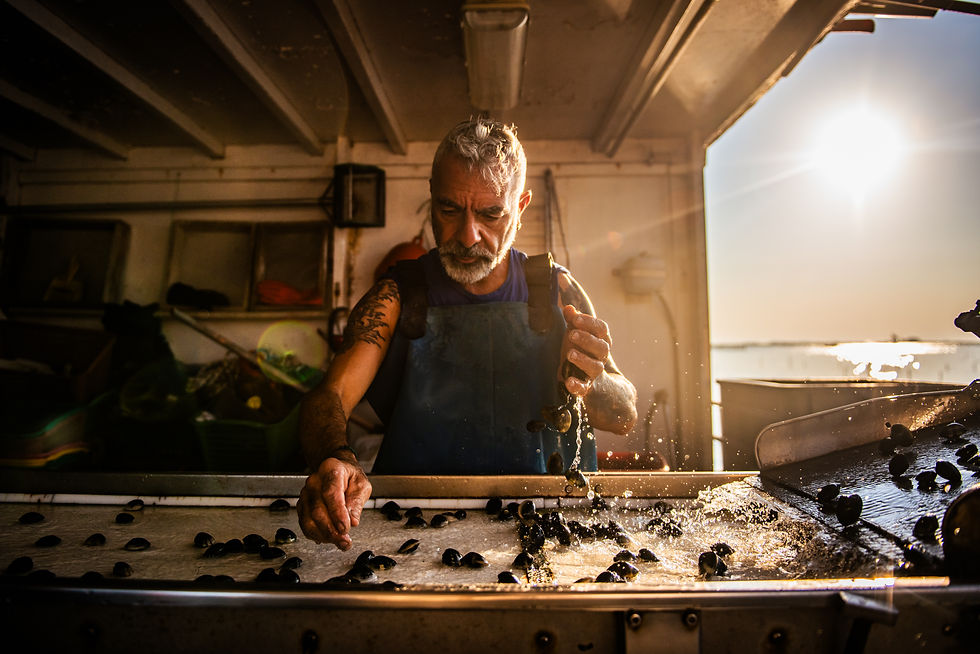
A mussel farmer points an infrared thermometer at the surface of his beds and reads 28.5 degrees. In laboratory conditions almost no Mediterranean mussels die below 26. At 28 a fifth are dead within five days, at 30 four out of five within a fortnight, and what kills is duration as much as peak. In the days around that reading the lagoon touched 32.
July 2026 was the hottest month ever recorded in the Mediterranean, a basin average of 27.07 degrees, with 94 per cent of its surface above normal and 79 per cent under an intense marine heatwave at some point, the highest share ever measured in July. The northern Adriatic reached 31 degrees, five to six above its seasonal values; the sea is warming here at roughly twice the rate of the global ocean. At the same time the river was failing. At Pontelagoscuro, its last gauging station, the Po was carrying 246 cubic metres a second against a seasonal average of 709, and the district remained in extreme drought even after the rains of late August. The sea had moved into the riverbed, up to 28 kilometres inland on the Goro branch, with two delta channels salt from mouth to top. The government declared a state of emergency in the Veneto, where the first half of the summer was the hottest since records began in 1992 and among the driest.
The lagoons are the last stretch of that river, and they are shallow: 60 to 70 centimetres on average at Goro, a metre and a half at Scardovari. Less fresh water means less exchange with the sea. Still water heats faster, holds less oxygen, and feeds the algae that consume what is left when they decompose.
In the Sacca degli Scardovari around a hundred tonnes of Cozza di Scardovari died within days, the last of the season's crop, still in the water and ready to harvest. Of roughly 1,300 tonnes produced this year, growers put the loss on what remained at close to 99 per cent. The consortium suspended sales of the only Italian shellfish with protected designation of origin status, keeping only what it grows offshore. In the Sacca di Goro, the leading site for Manila clams in Europe, growers reported losing up to 90 per cent of the clams on the beds. On 29 August the die-off reached the open sea as well, between Goro and Porto Garibaldi, where more than 60 per cent of the region's marine farming is concentrated: over 90 per cent of the crop lost, twenty to twenty-five thousand tonnes of market-ready mussels and of the seed that should have started next year. Direct damage has passed 50 million euros. The growers have asked Rome to declare a natural disaster. Nationally, climate change is reckoned to cost Italian professional fishing around 200 million euros a year.
None of this landed on a healthy industry. Since the invasive Atlantic blue crab took hold in 2022 it has cut commercial-size clam production by more than 70 per cent in places, with damage in Emilia-Romagna alone put at 16.8 million euros. Landings of the crab in the Veneto delta went from 97 tonnes in 2022 to around 630 the next year and more than 2,000 between April and August 2025; in the Sacca di Goro, 1,400 tonnes were taken in 2024 and 2,000 in 2025, and researchers describe this as the visible part only. A study published this year by the University of Bologna counted between one and 2.7 million eggs per female, averaging 1.6 million a brood. The species does best between 18 and 28 degrees, so the water that is killing the mussels suits it. It is also moving inland: work by the University of Ferrara, built on sightings gathered with fishermen, has tracked it more than 160 kilometres up the Po, the longest freshwater advance recorded in the Mediterranean basin, and links its first push upriver to the drought of 2022, when the weakened river let the sea in.
Catching it does not pay. Fishermen are forbidden by emergency order to put any crab back in the water and are paid 90 cents to a euro a kilo, while the bait for the traps alone costs two; most of the catch has no market. In 2025 the Veneto growers' consortium spent 1.39 million euros to destroy 1,163 tonnes of unsellable crab, at a cost per kilo higher than its price. The defences carry their own penalty: the anti-crab enclosures went from around ten to more than 120, and by slowing the movement of water inside them they made this summer worse.
The accounting is human. Between Comacchio and Goro the number of registered fishing businesses has fallen from around 350 to fewer than a hundred in two years. Across the river, aquaculture firms in the province of Rovigo are down 38.8 per cent and the workforce 35.1 per cent since 2023. The Goro system alone supports around 1,600 jobs and turns over more than 100 million euros a year. In Porto Tolle, of the roughly 1,450 people who work the beds, 680 are women, a share with no equivalent in European fishing: most came to the lagoon in the 1980s, when the local textile mills closed. This is a place with a long memory of leaving. In November 1951 the river broke and flooded the Polesine, on land that methane extraction had sunk by two to four metres; about a hundred people died, 180,000 were made homeless and some 80,000 left, one in three, most of them for good. Until 2007 it was the poorest province in northern Italy.
What makes this more than a story of loss is what the same people are doing about it. In the hatchery at Goro, clam seed is bred in tanks, fed on microalgae cultured on the premises and grown to 12 or 15 millimetres, the size at which a crab can no longer easily crush it, before being sown on the beds; the response to this summer has been to increase the pure oxygen injected into those tanks. On the beds there is nothing to inject. Seed is now the scarcest thing in the delta: the wild nursery grounds have been failing for three or four years for reasons nobody has established, the industry needs seven to eight billion juveniles a year to hold its production target, and imports have risen ten to twentyfold. In May the first clam hatchery in Goro opened, run with the University of Ferrara, six cooperatives and the local council, to study the crab, the anoxia and the heat together.
Others have changed species. Growers who farmed mussels all their lives have moved to oysters, which the crab cannot crush and which stand a marine heatwave better; they are grown in baskets and cages it cannot enter. Italian oyster production has gone from 33 tonnes in 2015 to around 500, against 85,000 in France, and in March last year oysters from the Sacca di Goro were served at the Italian Senate as the crab-proof shellfish. At Scardovari a former mussel farmer, who accepted a challenge from a French oysterman in 2010 and spent six years testing, now runs nine installations producing 350,000 oysters a year, lifting them clear of the water with a winch powered by solar and wind, a machine built to imitate Atlantic tides and improve a flavour, and now the only device in this lagoon capable of taking an animal out of water at 32 degrees. Public money is moving too, slowly: 1.5 million euros from Emilia-Romagna for 2026, an emergency commissioner and more than 50 million committed nationally against the crab, 150,000 laboratory-bred octopus released off the Romagna coast in August to test whether a native predator can hold it down, and a 14 million euro plan to dredge the delta channels and reopen the mouths to the sea, due to be completed in June 2031. A mussel is dead in five days.
And some have left the water altogether. In April a fisherman who lost forty years of work to the crab reopened his family boathouse on the lagoon as a restaurant, the first of a series planned along the same embankment. Three months later the mussels he serves could no longer be sold under their protected name.
Here a whole supply chain, from the birth of a clam to the plate, is adapting in real time to a sea that will not go back to what it was.


